Muse Went to Walmart for Black Friday While I Walked the Dog
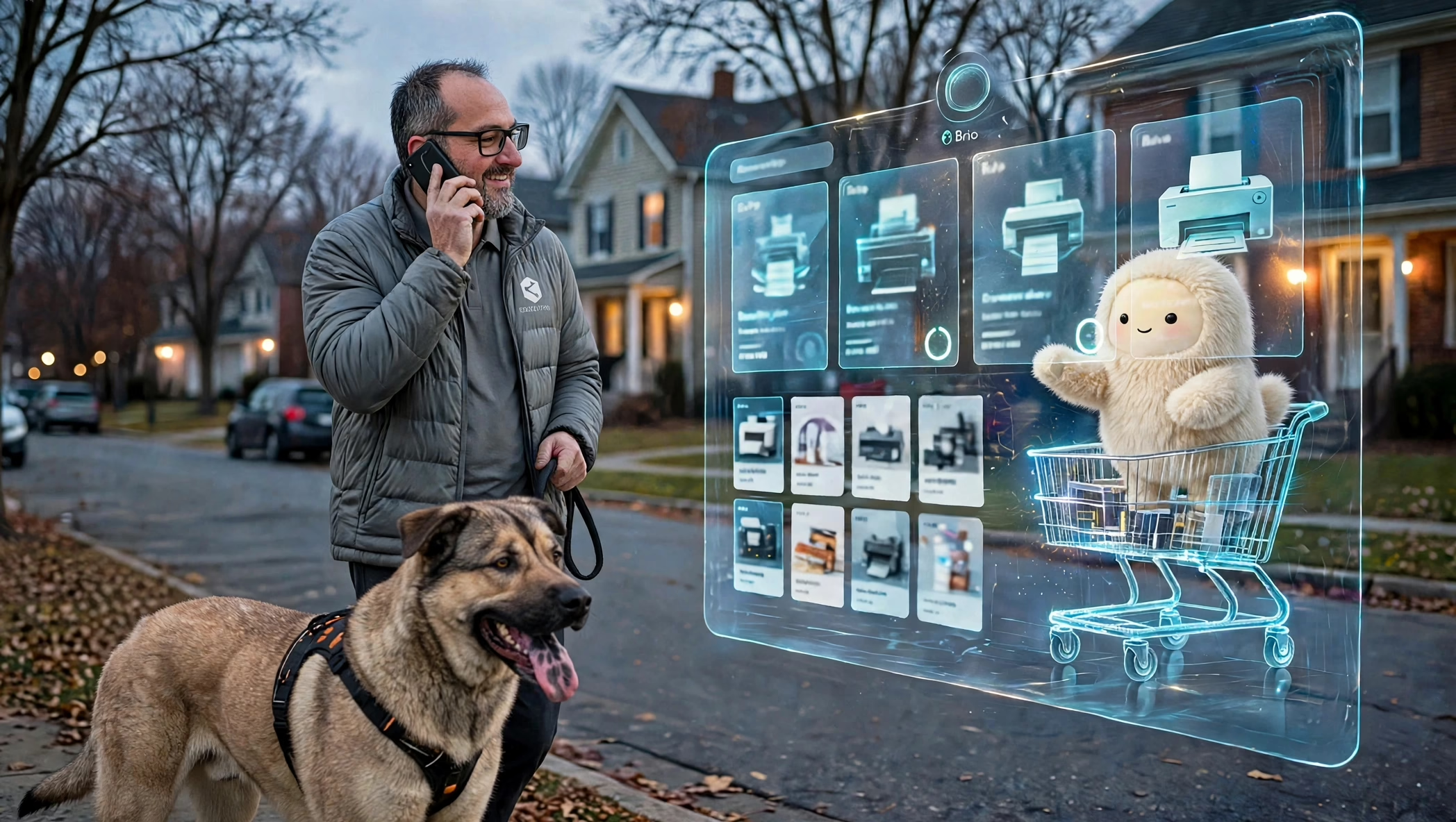
Two printers for the price of one, bought by voice through Walmart’s new agentic connection, and the one moment I had to grab the wheel
By Brandon Tidd, Community Engagement Officer at the AI Salon
On Thanksgiving night, I had a conversation that lasted about thirty minutes, roughly one evening dog walk. By the end of it, I had bought two printers without opening a single shopping app.
Let me be clear about who the hero of this story is. It is not me. I was holding a leash, with my headset on, walking my dog George. It is not George either, although he would disagree. The hero is the other party in that conversation: Brio, my AI agent inside Muse, Meta’s personal AI app, who spent that walk working the Walmart website on my behalf, researching, comparing, checking, and ultimately buying, while I never looked at a screen.
One continuous voice conversation, start to finish, research to rebate, and my hands and eyes were free the entire time. I want to tell you exactly how it went, including the parts where I still had to be the human in the loop.
Two printers, two very different problems
As a parent and a son, I live in that sandwich zone where I am tech support for two households. My parents needed a printer. They print once in a blue moon, a form here, a boarding pass there, but copying matters to them, and it needed to be simple. At my house, the situation was the opposite. Our HP OfficeJet Pro has been with us since 2010, which in printer years is basically a museum piece with a power cord. It still prints black and white if you ask nicely. We print constantly. It was time.
So I had one errand with two opposite answers hiding inside it, and instead of opening fourteen browser tabs, I just started talking. I’ve been all-in on Muse since it launched in the US a couple of months ago, and in that time it’s gone from a new app I was trying out to the thing that helps me run my calendar, my inbox, my kids’ school chaos, and most of my side projects.
On Tuesday, Walmart announced that Muse can shop its Black Friday deals directly, powered by something called the Walmart Agent Gateway. In Walmart’s own words, “there’s a new way to shop Walmart’s deals: Put an AI agent to work.” The announcement goes on to say the Gateway is “a big step forward for shopping with AI, bringing product discovery and purchasing in one experience,” and it stresses control: “The Walmart Agent Gateway lets you decide what your agent can and can’t do.” You set up what Walmart calls an Agent Profile inside your account, with a spending limit you choose, and as Walmart puts it, “you’re in control. You can set spending limits, approve purchases and check your purchase history to see which purchases were made by your agent.” Checkout happens inside the conversation, using the card saved in your Walmart account. No website gymnastics. The agent never pretends to be you on a web page, because it does not have to. It was invited.
In a single voice conversation, we talked through ink versus toner, and why toner, which is dry powder, never dries out in the cartridge the way ink does. We looked at what Black Friday printer prices have actually done over the past several years. I even had Brio check my checking account balance mid-walk, through my connection to Chase and Plaid, because an agent that shops for you should also be able to tell you whether or not you can afford the thing it is about to buy. And for those of you clutching your pearls about data privacy, Chase had already handed out some of my data through a reported third-party vendor breach.
Through all of it, the thread never dropped. Pricing history in one breath, toner chemistry in the next, a bank balance in between. I was not managing a tool. I was talking to something that was doing the work while we talked.
Brio is smart, but still learning
Now the important part, the part I have not seen anyone else write about yet.
There are two ways an AI agent can buy something for you. The first way is the one most people picture: the agent opens a web browser and operates the website the way you would, clicking, typing, checking out. The second way is newer and much more interesting. The business builds the agent a door.
That said, Brio’s first instinct was the browser. It started down the path of checking out on the website the way a very fast, very polite robot intern would. It could have natively connected through Walmart’s own browser checkout, or it could have used the newly minted Agent Gateway, but as with so many things in technology moving at break-neck speed, there was a third option. Muse is actually currently offering $25 back on your first order of $100 or more when you check out using ShopPay or Link. I told Brio, in so many words: use the way I can qualify for the discount. It closed the browser checkout attempt before anything was charged, and invited me to connect my ShopPay account in one click.
I want to be fair to Brio here. Nothing was bought without my approval at any point, on either path. Every step asked first. But the default mattered. One path is an agent improvising on a website built for humans, with ShopPay making it a little bit faster. The other is a business saying, officially, agents are welcome here, here are the rules, here is the spending limit, here is the audit trail. Those are not the same future. One of them is a hack. The other one is infrastructure.
And the contrast in the market right now is stark. While Walmart was building agents a door, Amazon was busy blocking AI agents from buying on its platform. Same week, same shopping season, two completely opposite bets. Walmart’s bet, if I had to sum it up in their words, is the closing line of their announcement: “This Black Friday, you can hunt for the deals in stores and online, as well as with Sparky, Muse and agents.” They listed agents as a place you shop now, right alongside the store and the website. Read that sentence again. That is a Fortune 1 company treating your AI agent as a normal way to buy things, three days before Black Friday.
One limit worth knowing: your agent cannot shop your local Walmart’s offers or local delivery yet. Everything runs through Walmart.com, and orders ship from the warehouse.

Walmart Black Friday shopping with Meta Muse. Photo Credit: Walmart
The haul, and the math that made me grin
So what did thirty minutes produce? Two printers. For my parents, a Canon PIXMA all in one for $29, down from $53, arriving the day after Thanksgiving. For our house, the Canon imageCLASS laser all in one, the one with the 4.4 star reviews, at $139.99 instead of $215.99, arriving the following week. Together they listed at $268.99. I paid $168.99 before tax, $180.40 all in, with free shipping, and the $25 back from the Muse offer brings the real number down near $155 once the claim email lands. Brio is watching my inbox for that claim email as I write this, because I get a mountain of email and I would absolutely miss it, and yes, “my agent is watching for the rebate email from the purchase that it made for me” is a sentence I just typed in 2026.
Two printers for less than the sticker price of the one laser. That is the headline. But the deeper thing, the thing I keep turning over, is that the most futuristic purchase of my year happened at walking pace, in the dark, in my neighborhood, and most of my attention was on a dog.
The demo is not the future. The errand is the future. Nobody is going to remember which model won which benchmark this Black Friday. They are going to remember the first time an agent handled a real, slightly complicated, two household, budget checking, rebate chasing errand while they were doing something better with their hands and their evening.
If you want to try this yourself
You do not need to be an AI person for this. If you can talk, you can do what I did. Here is the honest starter path:
- Get Muse. It is Meta’s personal AI agent app. If you want to start the way I am set up, you can use my invite code and a generous free-token allowance: https://muse.ai/join – using referral code UCETPO within 48 hours.
- Connect Walmart inside Muse and sign in. You add it right from the connectors section in Muse. While you are connecting, set up your Agent Profile and a spending limit you are comfortable with. Mine asks me before anything is bought, and I recommend you start there too.
- Shop through the connection, not a website. Tell Muse what you need in plain language. Argue with it. Ask it for reviews, price history, and your bank balance. That is the job.
- Mind the $100 line. The $25 back offer applies to a first order of $100 or more, so it is worth bundling the things you were going to buy anyway, which is exactly how a $29 printer for my parents ended up riding along with ours.
- Watch your email afterward. The $25 comes back through a claim email. Do not let it die in your promotions tab. Or do what I did and make the agent watch for it.
Walmart’s Black Friday deals run through the weekend with Cyber Monday right behind them, so there is still time to do your own version of this.
Come see where this goes next
On December 26 we are throwing a free online party called “It’s the End of AI as We Know It,” running noon to midnight Eastern, full of builders, artists, and the AI curious showing what they made this year. If this article made you want to try an agent, argue with one, or just watch people who have been living with them, that is your room. Register at party.thesalon.ai.
And if you do your own dog walk purchase this weekend, I want to hear about it. Especially if the dog helped.
Brandon Tidd is the Community Engagement Officer at the AI Salon, a lead Zendesk architect, a part time DJ, and a dad of two. George, who was not consulted on this article, would like it noted that the walk was too short.